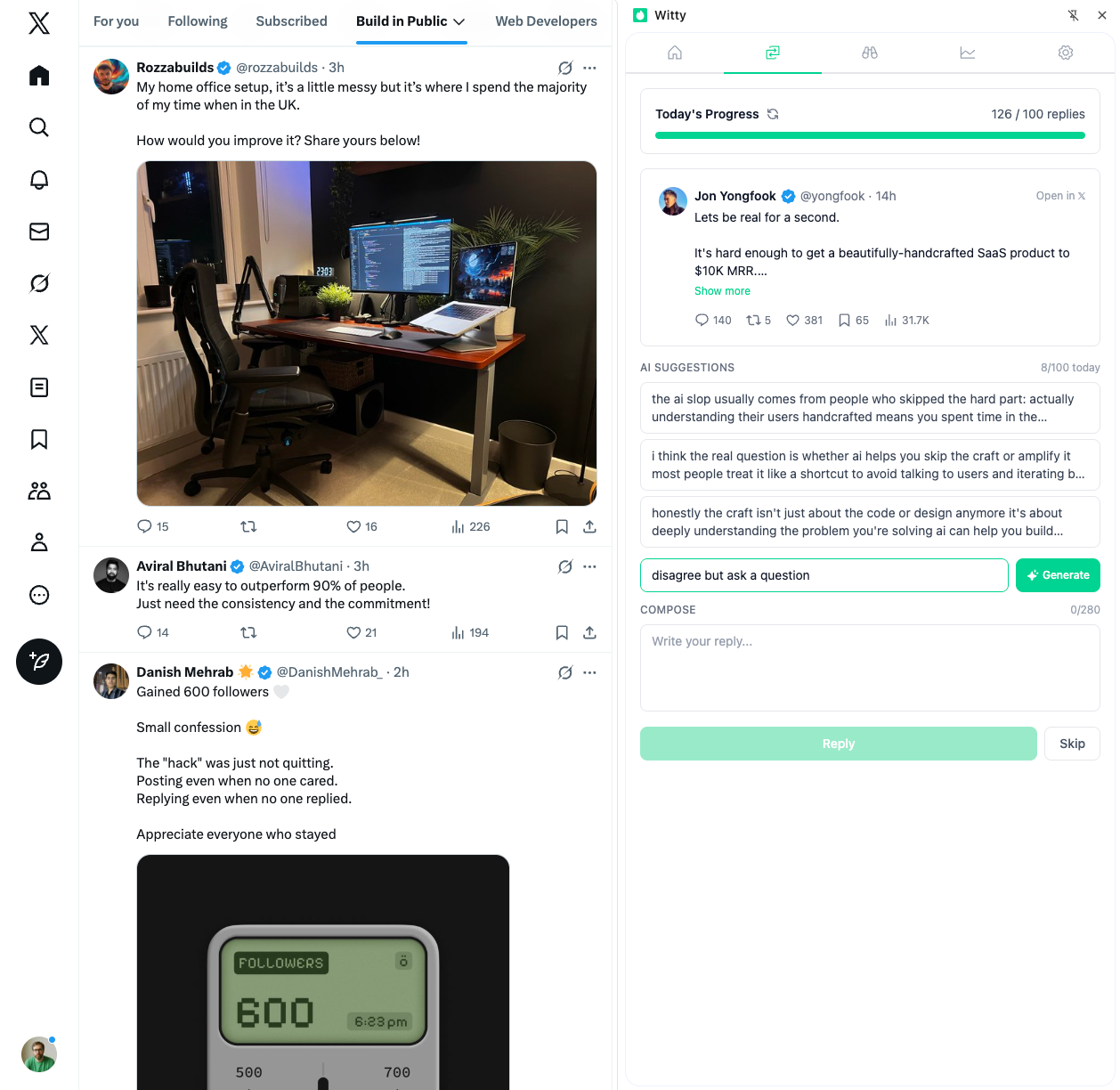
How to Spot Tweets Worth Replying To in Under 10 Seconds
How to Spot Tweets Worth Replying To in Under 10 Seconds
Your time is limited. The average tweet has a peak visibility window of 15-20 minutes. Scrolling aimlessly hoping to find something worth replying to is a recipe for wasted hours and minimal growth.
The solution is a rapid assessment system,a mental checklist that lets you spot high-value tweets in seconds, not minutes.
Here's how to train your eye for opportunity.
Why Tweet Selection Matters
Not all tweets are created equal. Reply to the wrong ones and you're invisible. Reply to the right ones and you tap into audiences you'd never reach otherwise.
The algorithm gives significant weight to reply-to-reply interactions,far more than simple likes. When someone responds to your reply, both of you benefit from expanded distribution. But you only get that opportunity if you're replying to tweets that generate conversation.
One creator tested a reply-heavy strategy and watched engagement jump from 2% to 6%, gaining 300 followers in a month. Another doing 50+ daily replies consistently hit 8K+ impressions per day. The leverage is real,if you're selective.
The 10-Second Assessment
When you see a tweet, run through this sequence:
1. Check the timestamp
Is it fresh? Tweets under 30 minutes old are the sweet spot. The algorithm tests each tweet with a small initial audience and measures response rates. Strong early engagement triggers expanded distribution. If you're the third reply on a fresh tweet from a relevant account, you're positioned for maximum visibility.
Tweets older than an hour rarely get algorithmic boosts afterward. You can still reply for relationship-building, but don't expect reach.
2. Scan the author
Complete profile with photo and bio? Reasonable follower-to-following ratio? History of original content, not just retweets? These signals indicate a real person with an actual audience. (Your own profile should be optimized too.)
Red flags: default profile picture, bio stuffed with random buzzwords, username with random numbers and letters, or a feed that's 90% retweets. Skip these,they're either bots, spam accounts, or people with no real engagement.
Premium/Blue subscribers get a 4x visibility boost within their network, so replies to verified accounts often perform better.
3. Evaluate the content
Can you add genuine value? Is the topic in your expertise zone? Does the tweet ask a question, make a claim you can expand on, or start a discussion you can contribute to?
Skip tweets that are complete thoughts with nothing to add. Skip controversial bait designed to provoke outrage rather than conversation. Skip anything with excessive hashtags (more than 2-3),that's usually promotional spam.
4. Read the engagement
Is momentum building? A healthy reply-to-like ratio indicates discussion potential. If a tweet has 50 likes and 2 replies, it's consumption content,people are reading but not talking. If it has 20 likes and 15 replies, there's a conversation happening.
Also check: are the existing replies thoughtful or generic? If the thread is full of "Great post!" comments, there's room for something substantive. If smart people are already debating, you'll need to bring something genuinely new.
The Quick Scoring System
Give each tweet a mental score. Award a point if it was posted within 30 minutes. Add another if the author has a complete, legitimate profile. Another if engagement is already building. Another if the topic is relevant to your expertise. Another if the content isn't controversial or divisive. And another if you can add genuine value.
A tweet scoring six points is a high-priority opportunity where you should reply immediately. Four to five points means it's worth considering, especially if you have something good to say. Zero to three points means skip and keep scrolling.
Where to Find High-Value Tweets
Random scrolling is inefficient. Build a system instead.
Turn on notifications for 10-20 accounts in your niche. When they post, you see it immediately and can be among the first responders. Use 𝕏 Lists to create curated feeds of people worth engaging with: one list for industry leaders who provide visibility, another for peers who offer relationship building, and another for up-and-comers where mutual growth is possible. (For more on finding the right accounts, see how to build watchlists.)
Use advanced search to find conversations. Add a question mark after keywords to find questions, like "content marketing ?". Filter by minimum engagement with min_faves:10. Exclude promotional links with -filter:links. Combine operators for precision: "startup founder" ? min_faves:10 -filter:links. Check specific hashtags in your niche during peak hours, which tend to be Tuesday through Thursday between 9 AM and 3 PM.
Red Flags That Waste Your Time
Learn to instantly recognize tweets to skip:
Spam signals: Gibberish content, copy-paste messages, overloaded hashtags, constant promotional links.
Bot patterns: Identical tweets repeated across the account, predictable posting intervals, high-volume activity with no genuine interaction.
Controversy traps: The algorithm amplifies emotionally charged content,each word referencing a rival viewpoint increases sharing odds by 67%. But engaging with divisive content damages your reputation and invites pile-ons. The momentary visibility isn't worth it.
Dead ends: Tweets older than a few hours with no engagement. Complete statements with nothing to add. Threads where the OP never responds to comments.
The Hierarchy of Reply Value
Not all interactions are weighted equally by the algorithm. Replies sit at the top, showing deep engagement and conversation interest. Quote Tweets come next, adding commentary and carrying high algorithmic value. Retweets follow, endorsing content to your followers. Likes are the simplest signal and carry the lowest weight.
A tweet with more replies than likes often indicates higher engagement potential because people are motivated to discuss, not just passively consume. These are your prime targets.
Time Investment Reality
Quality replies take about 30-60 seconds to compose. Scanning and assessment should take 5-10 seconds per tweet. If you're investing 45 minutes a day in replies, you should be producing around 30 solid ones.
The math works like this: from 100 daily replies, expect 10-20 to perform well, 10-50 to get decent engagement, and about 70% to underperform with just 2-3 likes. That's normal. The winners carry the strategy.
But if you're selective,only replying to high-scoring tweets,your hit rate improves dramatically. Better to post 20 targeted replies than 50 random ones.
Building Pattern Recognition
After a few weeks of deliberate practice, you'll develop instincts. You'll know which accounts consistently spark good conversations. You'll recognize which content formats perform in your niche. You'll sense timing patterns specific to your audience.
Track what works. Notice which account sizes deliver the best engagement on your replies. Pay attention to which topics generate the most discussion. Record what time of day your target accounts post. Observe which question formats get the most responses.
This data refines your scanning. Eventually, spotting a high-value tweet becomes automatic. You'll feel it before you finish reading.
The 5-Minute Daily Routine
If you're short on time, here's a minimal effective approach:
Minute 1: Check notifications. Reply to anyone engaging with your content first.
Minutes 2-3: Scan your priority list (3-5 accounts you most want to build relationships with). Look for tweets posted in the last 30 minutes.
Minutes 4-5: Run one search for your primary keyword with the ? operator. Find a question you can answer well.
That's five replies in five minutes, all targeted at high-potential tweets. Done consistently, it compounds. (For a more comprehensive approach, see the full daily engagement system.)
The Bottom Line
Most people treat replies as an afterthought,something they do when they have time, without strategy or selection criteria. That's why most replies disappear.
The creators who grow through engagement have a system. They know what to look for. They scan quickly, filter ruthlessly, and invest their energy only where it counts.
Train your eye. Build your lists. Learn the patterns. In 10 seconds, you should know whether a tweet is worth your reply,or just noise to scroll past.
Related Articles

How to Make Your Replies Discoverable
You write a thoughtful reply. It's insightful, valuable. Then it sits there. A few likes. No profile visits. No one discovers you. Not all replies are created equal in the algorithm's eyes. Understanding what makes replies visible changes everything.
5 min read
How to Diagnose Low Profile Visits
Profile visits are the bridge between someone seeing your content and someone following you. Without them, followers don't happen. If visits are consistently low, you've identified a critical bottleneck. There are five root causes, and the fix depends on which one applies to you.
7 min read
How to Grow on X in 2026 Without Posting 10x a Day
The accounts posting 15 times a day aren't necessarily growing faster than you. Metricool's analysis of 2 million posts shows clear diminishing returns beyond 10 daily posts. The real sweet spot is lower than most advice suggests, and easier to sustain.
5 min readYou've done the learning. Now put it into action.
Witty finds tweets worth replying to and helps you craft responses in seconds. Grow your audience without the grind.
No credit card required.