Streak-Based Growth: The Psychology of Daily Engagement
Streak-Based Growth: The Psychology of Daily Engagement
Behavioral economists have found that individuals are willing to expend 40% more effort to maintain a streak than to achieve the same behavior without streak tracking.
That's not willpower. That's brain chemistry. And you can use it.
The Science of Streaks
When you complete a habit, dopamine neurons fire. This "feel-good chemical" reinforces the behavior, making repetition more likely. Each completion strengthens neural pathways. Over time, activity shifts from conscious decision-making regions to automatic behavior regions.
Research consistently demonstrates the brain's preference for automatic behavior. Studies show that 65% of daily behaviors are driven by habit rather than active choice, and 88% of daily behaviors are habitually executed with minimal conscious oversight. Perhaps most striking, about 40% of daily activities are performed in almost the same situations each day. The brain is designed for automation, and streaks leverage this design.
How Long Does Habit Formation Actually Take?
The popular "21-day myth" is wrong. It originated from a plastic surgeon's observation that patients took about 21 days to adjust to their appearance,not from habit research.
A comprehensive 2025 systematic review analyzing 20 studies found the median time to habit formation falls between 59 and 66 days, with mean times ranging from 106 to 154 days. Individual variability spans an enormous range, from as few as 4 days to as many as 335. The takeaway is clear: plan for 2-3 months minimum, not three weeks.
Critical milestones:
Research on gym attendance found approximately 50% of members lost their streak at the 6-week point. This emerged as the moment where habits either solidify or collapse.
If you can make it to week 6, your odds of long-term success increase dramatically.
Why Streaks Work Psychologically
Several psychological principles make streaks powerful:
Loss aversion: People are more motivated to avoid losing progress than to gain rewards. A 100-day streak feels like a trophy worth protecting. Breaking it feels like losing something valuable.
Goal gradient effect: The closer you get to achieving a goal, the harder you're willing to work. You won't want to break your streak on day 9 out of 10.
Consistency bias: We have an instinctual desire to remain consistent with previous actions. Streaks leverage this by encouraging regular activity that builds a consistent self-image.
The data confirms these principles at scale. Users who maintain a Duolingo streak for 7 days are 3.6x more likely to stay engaged long-term, and when Duolingo introduced an iOS widget displaying streaks, user commitment increased by 60%. Apps combining streak and milestone mechanisms see 40-60% higher daily active users. Duolingo itself grew daily active users by 4.5x over four years through gamification, demonstrating the compound power of these psychological principles.
Applying Streaks to X Engagement
The same psychology that makes Duolingo addictive can power your X growth.
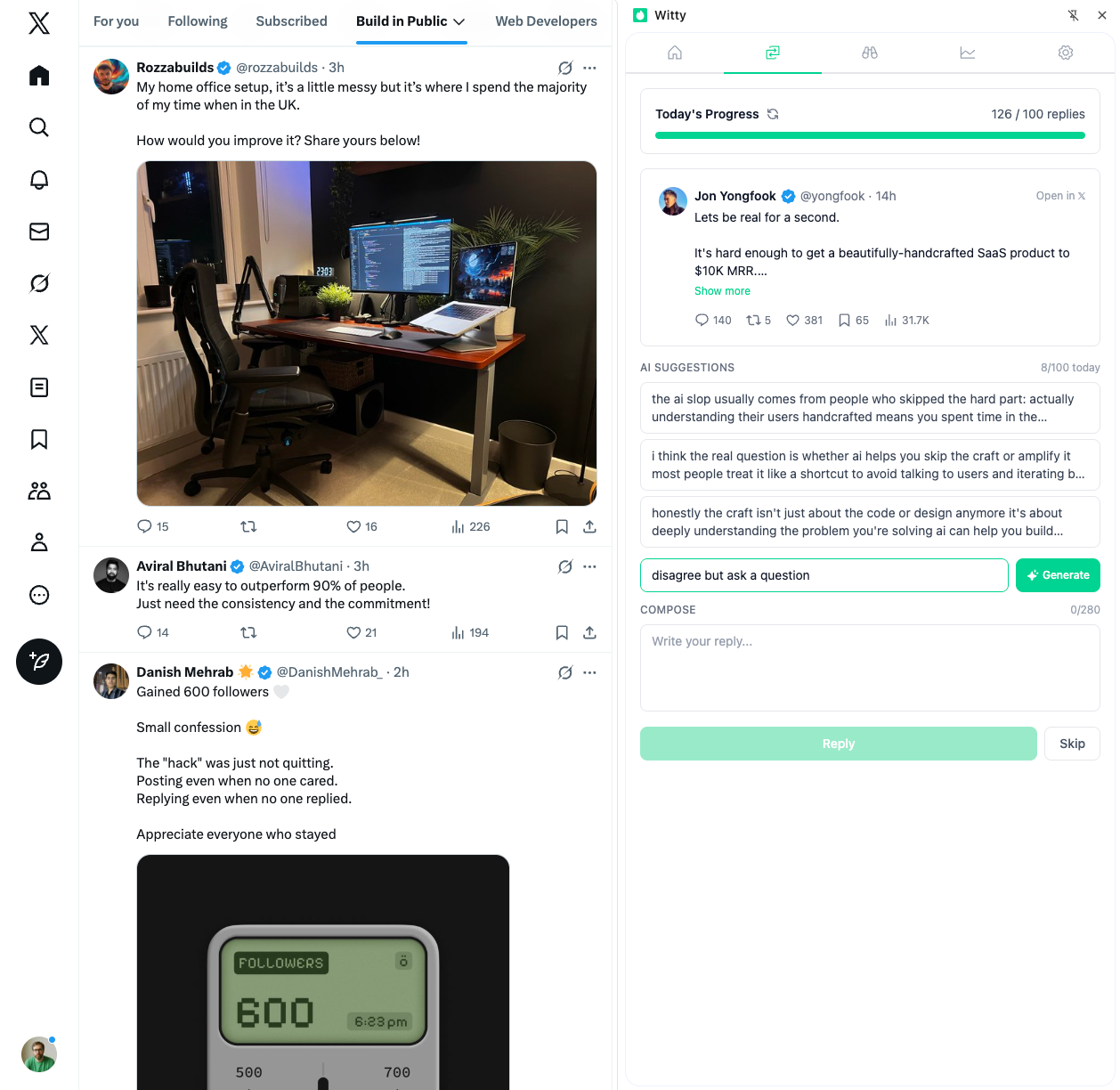
The habit loop formula applies directly to 𝕏 engagement. The cue might be your morning coffee being poured, a phone notification, or simply opening the app. This triggers a craving to connect, learn, or be recognized. The response is writing 3-5 thoughtful replies to targeted accounts. The reward comes through engagement, new followers, and a sense of contribution.
Why tracking creates rewards:
Each checkmark is a tiny reward, activating the brain's dopaminergic system. The loop becomes: Cue > Behavior > Reward > Repeat. Tracking provides both the cue (the visual grid) and the reward (the checkmark).
Research shows that simple yes/no tracking outperforms complex measurement systems. Individuals using binary tracking maintained habits 27% longer than those using detailed metrics during the formation phase.
Building Your Engagement Streak
Start smaller than you think:
Leaders who began with minimal viable habits were 2.7x more likely to maintain long-term habits than those starting with ambitious targets.
The minimum viable engagement:
| Level | Time | Actions |
|---|---|---|
| Ultra-Tiny | 2 min | Write 1 thoughtful reply |
| Tiny | 5 min | Reply to 3 tweets from target list |
| Small | 10 min | 5 replies + respond to any received |
| Standard | 15 min | 5-10 replies + 5 min community engagement |
Start at Ultra-Tiny. Only increase when the current level feels automatic. For a complete 15-minute framework, see the 15-minute daily loop.
Timing matters:
78% of successful habit-formers complete key habits before 9 AM. Morning practices generally exhibit greater habit strength. Executives who scheduled specific time blocks were 3.2x more likely to maintain habits than those who tried to "fit them in."
Recovering from Broken Streaks
Here's where most people fail: they break a streak once and quit entirely.
Why broken streaks are devastating:
When people break their streaks, it's especially demotivating because they've failed the goal of keeping the streak alive AND missed the behavior itself. Breaking a streak feels like a loss,you lose both the streak and your feeling of progress.
People who think in binary terms (perfect/broken) are 3.2x more likely to abandon goals entirely after their first perceived "failure."
Evidence-based recovery:
Practice self-compassion. Studies show the harsher we are on ourselves for breaking streaks, the less likely we are to re-establish them.
Reframe the failure. A broken streak isn't a failure,it's a pause. If you've missed a day, nothing is ruined. You didn't erase what came before.
Use the "fresh start" effect. Mark your calendar with the day you'll restart. There's something powerful about clean slates,new weeks, new months, or even Mondays.
Start small again. Don't jump back at full throttle. Begin with the minimum viable version to rebuild momentum.
Focus on overall progress. Lasting change is built quietly, imperfectly, over time. What matters most is showing up more often than not.
The critical insight:
In a 12-week field study, missing once did not materially affect habit formation. What killed progress was letting a slip turn into a slide.
80% consistency produces nearly identical long-term results to 100% adherence, while being significantly more sustainable psychologically.
When Streaks Become Unhealthy
Streaks can cross from helpful to harmful. When users feel trapped by their own success, streaks transform from tools into sources of anxiety. Learn more about avoiding the posting treadmill.
Warning signs include completing activities you don't enjoy simply to avoid breaking the chain, prioritizing streaks over sleep, family time, or work, experiencing anxiety about maintaining long streaks, and feeling withdrawal-like symptoms when considering stopping.
Snapchat streaks offer a cautionary tale:
Research suggests Snapstreaks can lead to compulsive behavior, with users prioritizing them over school, family, or sleep. The fear of losing a streak creates stress that undermines the supposed benefit.
Healthy streak design builds in flexibility. Duolingo's "Streak Freeze" feature allows pausing without losing your streak, reducing churn by 21% for at-risk users. The messaging normalizes breaks with language like "Life gets busy. Your streak freeze protected your 40-day streak." If daily pressure becomes unhealthy, consider measuring streaks by week rather than by day.
Building Sustainable Daily Habits
The key is consistency over intensity. A daily 10-minute engagement practice yields far greater long-term benefits than sporadic hour-long sessions.
The habit stacking formula:
"After [current habit], I will [new habit]."
For example, after pouring your morning coffee, you might write 3 replies to your target list. After sitting down on the train, you could spend 10 minutes on quality replies. After finishing your first work session, you might write 2 thoughtful replies. Executives who used habit stacking reported 64% higher success rates than those establishing standalone habits.
The environment matters:
Environmental design involves structuring your surroundings to facilitate desired habits. Put X on your home screen. Create a list of target accounts for easy access. Remove friction.
James Clear's four laws of behavior change provide additional guidance. Make it obvious through visible triggers. Make it attractive through enjoyable actions. Make it easy by reducing friction. Make it satisfying through immediate rewards. Each law reinforces the others, creating a system where the desired behavior becomes increasingly automatic.
Your Streak-Based Growth Plan
During weeks 1 and 2, focus on initiation. Choose an anchor habit like morning coffee or your commute, start with an ultra-tiny commitment of just 1 quality reply, celebrate immediately after completion, and track with a simple yes/no checkmark. The goal is establishing the behavior, not maximizing volume.
Weeks 3 through 8 shift to building. Gradually increase volume only when the current level feels automatic. Maintain 80% or better consistency while allowing some misses. If you miss a day, restart immediately and commit to never missing twice in a row.
By weeks 9 through 12, automaticity should emerge. The habit feels natural and requires minimal willpower. Continue tracking to prevent decline, and evaluate whether your pace is sustainable long-term.
From month 3 onward, you enter maintenance. The habit becomes part of your identity, shifting from "I reply on 𝕏" to "I'm someone who engages daily." Periodically audit and evolve your approach as needed, and build in intentional rest periods to prevent burnout. For guidance on finding the right frequency, see content cadence.
The streak itself isn't the goal. The relationships, visibility, and growth that come from consistent engagement are the goal. The streak is just the tool that gets you there.
Related Articles

Setting Realistic X Goals (That Won't Burn You Out)
10,000 followers in 30 days. 100 replies daily. Post every 4 hours. Most growth goals are designed to create burnout, not success. Sustainable goals match your life circumstances and compound over time. Here's how to set targets that actually work.
6 min read
Content Refresh: Turning Old Posts Into New Wins
Your best old posts are invisible to your new followers. That thread you spent hours crafting three months ago? Your audience has doubled since then, and most of them have never seen it. Content refresh isn't about being lazy. It's about being smart.
8 min read
Signal vs Noise on X: A Filtering Checklist
With 611 million monthly active users, your ability to separate valuable content from time-wasting noise has become essential. Most people let the algorithm decide what they see. The result: hours lost to rage bait and content that leaves them anxious rather than informed.
4 min readYou've done the learning. Now put it into action.
Witty finds tweets worth replying to and helps you craft responses in seconds. Grow your audience without the grind.
No credit card required.