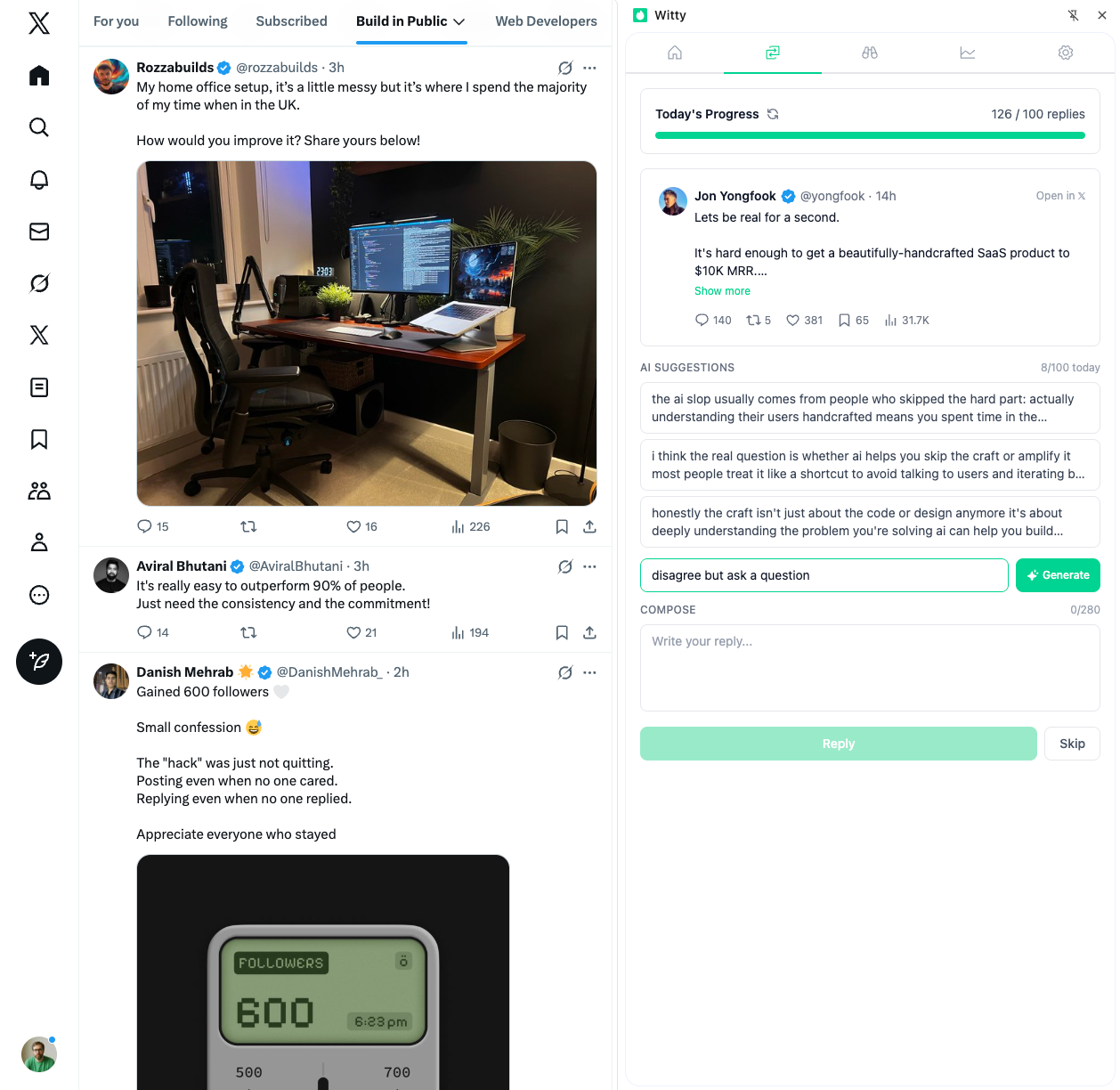
How to Reply to Big Accounts Without Sounding Desperate
How to Reply to Big Accounts Without Sounding Desperate
There's a particular cringe that comes from watching someone reply to a big account. You know the type: "Love this! 🔥🔥🔥 Would love to connect!" or "Great insight! Check out my thread on this topic..."
The creator with 200K followers scrolls past. Thousands of people see the desperate attempt. Nothing good comes from it.
And yet,replying to larger accounts is one of the most effective growth tactics on X. The visibility is real. The opportunity to be seen by new audiences is legitimate. The problem isn't the strategy; it's the execution.
Here's how to engage with big accounts in a way that actually gets noticed,without sacrificing your dignity.
Why Engaging with Big Accounts Works (When Done Right)
The math is simple. A reply to someone with 100K followers can be seen by their entire audience,people who've never heard of you. If that reply adds value, some percentage will click your profile. If your profile is dialed in, some percentage will follow.
But the math only works if you stand out. Big accounts get hundreds of replies on popular tweets. Most are noise: "Great post!" "So true!" "This!" These get buried, ignored, or actively filtered.
The algorithm helps quality rise,replies that generate engagement get promoted in the thread. But you have to earn that engagement. You have to say something worth responding to.
The Fundamental Mistake: Acting Like a Fan
Here's what separates invisible replies from noticed ones:
Fans ask for attention. "Would love your thoughts on my work!" "Can you check out my profile?"
Peers add value. They share relevant experience. They contribute a perspective the original post didn't include. They ask questions that advance the discussion.
If you act like a fan, you become just another fan,part of the undifferentiated mass in someone's mentions. If you act like a peer, you position yourself as someone worth knowing.
The mindset shift is crucial: you're not hoping to be noticed. You're contributing to a conversation.
What Big Accounts Actually Notice
People with large followings are drowning in notifications. They cannot read everything. So they filter.
What gets through the filter:
Genuine value. A reply that teaches them something, challenges their thinking, or adds an angle they hadn't considered. One well-crafted reply that could stand alone as a tweet beats ten "great points" comments.
Early timing. Replies in the first 30 minutes of a post get disproportionate visibility. The creator is most likely to be online and checking responses. Early replies also have time to accumulate their own engagement, pushing them higher in the thread.
Familiar names. After you've engaged consistently over weeks, your name starts to register. "Oh, this person again." That familiarity compounds. The twentieth thoughtful reply from someone is noticed differently than the first.
Quality questions. A question that shows you've thought about the topic invites response. "Have you found this changes at scale?" is better than "Would love to connect!"
Respectful disagreement. Counterpoints that are specific and evidence-based stand out in a sea of agreement. "Interesting,I've actually experienced the opposite in B2B contexts. Could be an industry difference?" This shows you're thinking, not just validating.
What Gets Ignored
Generic acknowledgments. "Great post!" "So true!" "This!" These add nothing and disappear.
Self-promotion. "I wrote about this on my blog!" "Check out my thread!" Even if relevant, the pitch kills the conversation.
One-word responses. "Facts." "Interesting." "Agree." Low effort signals low value.
Emoji-only replies. The algorithm treats these as low-quality.
Questions that are actually requests. "Can I pick your brain?" "Would you mentor me?" These are asks disguised as questions. They extract value instead of adding it.
The Slow Build Strategy
Building recognition with larger accounts is a marathon. Expect nothing from any single reply. Expect everything from consistent presence over months.
Weeks 1-4: You're invisible. Your replies are good but unknown. The creator doesn't recognize your name. Keep showing up anyway.
Weeks 5-8: "I've seen you before." A vague sense of familiarity forms. Your replies might get a like from the creator. Still no relationship, but you're emerging from the noise.
Weeks 9-12: "Oh, it's you again!" Recognition. Your name registers. The creator might reply to your comment. Other regulars in their community start to recognize you too.
Months 4+: "We should talk." The relationship has graduated from public to private. DM conversations start. Collaboration opportunities emerge. You've become part of their circle, not their audience.
This timeline assumes consistent, valuable engagement. Skip a few weeks and you reset the clock. Show up with generic comments and you never progress past week one.
How to Add Value Without Showing Off
The best replies demonstrate expertise without explicitly claiming it. Show, don't tell.
Drop a specific number. "Tested this exact approach,saw a 40% lift in engagement when I switched from afternoon to morning posting." The specificity is credibility.
Share a relevant failure. "Tried this last year and crashed hard. The missing piece for me was [specific insight]. Once I added that, everything clicked." Vulnerability plus lesson learned is compelling.
Offer a framework. "I think about this as a 2x2 matrix: high effort/low effort crossed with high reach/low reach. Reply strategy sits in the low-effort, high-reach quadrant." Frameworks show structured thinking.
Ask a genuinely curious question. "Have you noticed this changes as account size grows? I've seen different dynamics above 10K followers." Curiosity that advances the discussion is valuable.
Synthesize the conversation. If a thread has multiple perspectives, summarize them thoughtfully. "Reading through, seems like there are two camps here. The synthesis might be: [your integration]." This shows you're processing, not just reacting.
The DM Bridge (Done Right)
Eventually, relationships need to move to DMs. But cold DMs to big accounts almost always fail.
The bridge: build the relationship publicly first. Engage consistently for weeks. When you do DM, reference the public interaction:
"Hey,been enjoying our exchanges on [topic]. Your point about [specific thing] made me rethink my approach to [specific application]. Just wanted to say thanks. Keep creating."
Notice what's not there: no ask. No pitch. No "can we hop on a call?" Just appreciation, with a specific reference proving you've been paying attention.
After several exchanges like this, asks become natural. But they come from a place of established relationship, not cold outreach.
The Peer Positioning Principle
The core mindset: you are a peer, not a fan. This doesn't mean pretending you're at their level of influence. It means approaching the interaction as an equal exchange of ideas.
Fans say: "You're so amazing! I love everything you do!"
Peers say: "Interesting perspective. Here's what I've seen in my experience..."
Fans ask: "Can you look at my work?"
Peers offer: "This connects to something I've been experimenting with,happy to share what I've learned if it would be useful."
Fans seek validation: "Am I doing this right?"
Peers contribute: "One nuance I'd add to this framework..."
The peer positioning comes through in language, but it's rooted in genuine confidence that you have something to contribute. If you don't believe you have value to add, your replies will betray that.
When to Persist vs. When to Move On
Not every big account will become a relationship. Some people never check their replies. Some have filters that hide anything without enough engagement. Some simply aren't a fit for your niche or style.
Signs to keep engaging:
- Occasional likes on your replies
- The creator replies to your comments sometimes
- You're getting engagement from their audience
- The content is genuinely relevant to your expertise
- You enjoy the interactions
Signs to move on:
- Zero acknowledgment after 8-10 quality replies
- The content has drifted away from your niche
- Engaging feels forced or performative
- Their audience doesn't engage with your replies either
Moving on isn't failure. It's resource allocation. Redirect your energy to accounts where traction is building. (Use watchlists to track and manage your target accounts.)
The Long-Term Payoff
Done well, strategic engagement with larger accounts creates compounding benefits:
Visibility: Their audience sees you repeatedly. Some become your followers.
Credibility by association: Being seen in conversation with respected accounts signals your own credibility.
Relationship leverage: When those accounts think of someone in your space, your name comes to mind.
Collaboration opportunities: Guest posts, podcast appearances, co-created content, mutual promotion.
Network effects: Their connections become accessible through warm introduction.
None of this happens from one clever reply. It happens from sustained presence over time, adding value consistently, treating every interaction as a contribution rather than a transaction.
Related Articles

Reply Templates That Don't Feel Like Templates
Templates have earned their bad reputation. But behind every effective reply is a structure. The best repliers aren't writing from scratch each time. They're adapting proven patterns to each situation. The difference between a template and a framework is flexibility.
7 min read
How to Use Lists on X for Faster Growth
Lists are one of the most underutilized growth tools on X. They let you create curated feeds for targeted engagement without cluttering your main timeline. The reality: 30 minutes of strategic list-based engagement often generates more qualified followers than 2 hours of content creation.
6 min read
The '15-Minute Daily Loop' for X Growth
30 minutes of focused, strategic activity beats 2 hours of aimless scrolling. This isn't motivational fluff. It's how the math actually works on X. Here's how to make 15 minutes count.
7 min readYou've done the learning. Now put it into action.
Witty finds tweets worth replying to and helps you craft responses in seconds. Grow your audience without the grind.
No credit card required.