The Minimalist Content Workflow for X
The Minimalist Content Workflow for X
The average adult makes 35,000 decisions a day. Every time you sit down to post on 𝕏, you're adding to that cognitive load: What should I say? When should I post it? Should I include an image? What hashtags?
Most content workflows try to solve this by adding more,more tools, more processes, more steps. But the real solution is subtraction.
A minimalist content workflow eliminates unnecessary decisions while maintaining quality output. It's how you stay consistent without burning out.
The Cost of Complexity
Complexity kills consistency in two ways:
Decision fatigue. When your workflow requires too many choices, you opt for the easiest path,which usually means not posting at all. Research shows that decision quality declines as we make more choices throughout the day.
Tool overload. Too many tools make processes more complex, not simpler. Every new app adds learning curves, subscription costs, and potential points of failure.
Context switching. It takes an average of 23 minutes to refocus when switching between tasks. Jumping between five different tools means losing hours to transition time.
The minimalist approach counters all three by reducing decisions, consolidating tools, and batching similar tasks.
The Minimalist Tech Stack
You need exactly four elements.
The first is one planning tool where you capture ideas and plan content. Options include Notion for flexibility and databases, Google Sheets for simplicity and universal access, or Apple Notes for speed and cross-device sync.
The second is one creation tool where you write and edit. This might be the native 𝕏 composer, a simple text editor, or an AI assistant for drafts.
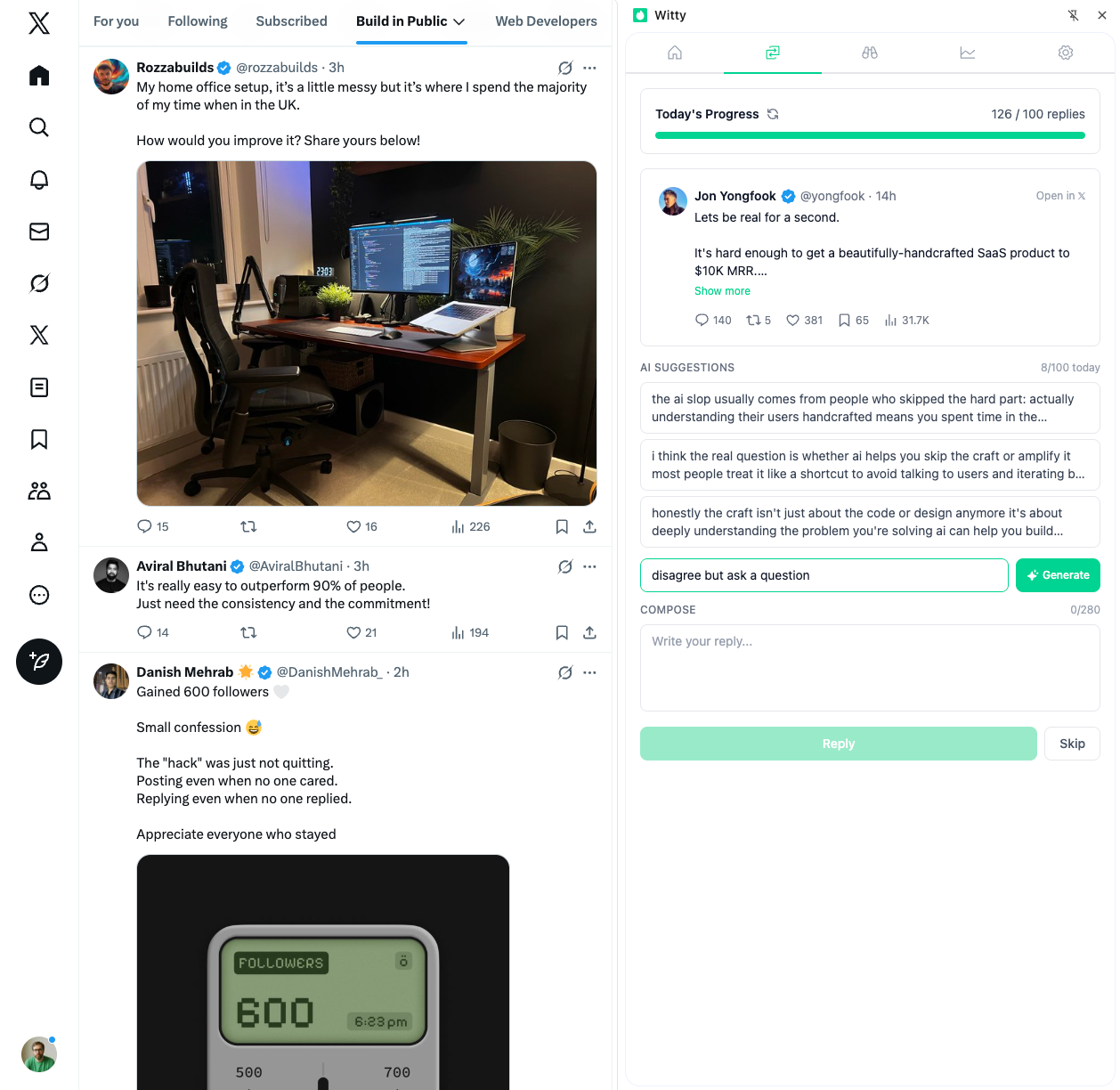
The third is one engagement tool to manage your 𝕏 workflow. A Chrome extension like Witty keeps everything in your browser where you're already working, with features like reply queues and AI suggestions that fit a minimalist approach.
The fourth is documented processes: written checklists and templates that remove guesswork.
That's it. More than this creates friction. Less than this creates chaos.
The Weekly Workflow
Monday: Ideation (30 minutes)
Review your idea capture file and move promising concepts to your content calendar. Set themes for the week based on your content pillars (the 3-5 core topics you consistently cover), trending conversations in your niche, and engagement patterns from previous weeks. This decision reduction means instead of deciding what to post daily, you decide once per week.
Tuesday: Creation (60-90 minutes)
Batch create all content for the week in one session. Use templates for recurring formats like thread starters, single posts, and reply prompts. Write everything, edit nothing. Get ideas down first. When creation and editing happen separately, you make fewer choices per session.
Wednesday: Review (30 minutes)
Edit Tuesday's drafts. Run each through your pre-publish checklist: Is it relevant to your niche? Does it add value? Is the hook compelling? Is the tone right? Cut anything that doesn't pass. A checklist means consistent quality without subjective judgment calls.
Thursday: Scheduling (20 minutes)
Load approved content into your scheduling or queue tool. Set optimal posting times.
Review engagement from earlier in the week. Adjust timing if needed.
Decision reduction: Scheduling in batches means you handle timing once, not daily.
Friday: Engagement (ongoing)
Focus entirely on replies and interaction. No new content creation.
Use your reply swipe file for inspiration. Prioritize high-value accounts.
Decision reduction: By separating creation and engagement days, you're not constantly switching modes.
The Minimum Viable Content Strategy
The key insight from lean methodology: launch with just enough to satisfy requirements, then iterate based on feedback.
Applied to 𝕏, this means starting small. It's better to find a sustainable posting cadence than to try posting daily for two weeks and then quit for six months. Consistency builds habit. Focus on one format by mastering single posts before attempting threads, and threads before video. Don't try everything at once. Measure one metric, picking engagement rate or reply count rather than trying to track both plus impressions plus follower growth plus click-through rate. Track one thing, improve one thing. Start with one content pillar and expand to 3-5 pillars only after you've proven you can consistently produce quality content on that single topic.
Templates That Save Time
The 70-30 Content Mix
Aim for 70% engagement-focused content that informs, educates, or entertains, with 30% promotion-focused content covering products, services, and calls to action. This ratio keeps your feed valuable while still allowing business goals.
The Content Pillar Rotation
If you have four content pillars and post four times weekly:
- Monday: Pillar 1
- Tuesday: Pillar 2
- Wednesday: Pillar 3
- Thursday: Pillar 4
No daily decisions about topic. The rotation is pre-set.
The If/Then Rules
Create automatic decisions. If a new idea comes during focus time, add it to the idea capture file rather than acting now. If a post takes more than 10 minutes to write, it's trying to be too complex, so simplify. If engagement is below average, review timing and hook rather than overhauling the entire strategy. These rules eliminate in-the-moment decision-making.
The Repurposing Multiplier
94% of marketers repurpose content. Here's why it's essential for minimalism:
One idea produces multiple formats. A thread becomes five standalone posts. A popular post becomes a longer thread. A thread becomes a carousel image. A carousel becomes a video script. The 1:5 rule states that every piece of original content should yield at least five derivative pieces.
This isn't lazy,it's efficient. Content repurposing saves 60-80% of creation time while potentially tripling your content ROI.
Strategic repurposing can boost reach by 300%. Buffer increased their content reach by 400% after implementing systematic repurposing.
Batching for Minimalists
The full content batching approach dedicates one day for ideation, one for creation, one for editing, one for scheduling, and one for engagement. The minimalist version compresses this dramatically: one hour for ideation and creation combined, thirty minutes for editing and scheduling combined, and ongoing engagement throughout the week. Total time comes to roughly 90 minutes per week of focused content work, plus engagement time.
Creators who batch report feeling 26% more confident in their planning and creative flow. Those who adopted batching saw a 30% drop in stress days.
Avoiding Common Pitfalls
The Tool Trap
You don't need a specialized hashtag research tool, a separate analytics dashboard, an AI writing tool AND a grammar checker AND an editing app, or three different scheduling platforms. More tools equal more complexity, which equals less consistency.
The Perfection Trap
A good-enough post published beats a perfect post stuck in drafts. Embrace imperfection,it's more human anyway.
Done is always better than perfect. Creating less content helps develop a creative habit better than sporadic attempts at excellence.
The Comparison Trap
Someone else's elaborate content system doesn't mean yours needs to be elaborate. Find what works for your capacity, schedule, and goals.
Only 29% of marketers with a documented content strategy say it's extremely effective. The complexity of your system isn't what determines success,the consistency of execution is.
The Sustainability Test
Ask four questions about your workflow. Can I maintain this during a busy week? If not, simplify. Does it require fewer than 10 decisions per week? If more, automate or eliminate. Could I explain it in under two minutes? If not, it's too complex. Am I using every tool I'm paying for? If not, cut the extras. If your workflow passes all four tests, you've built something sustainable.
Getting Started
In your first week, choose one planning tool, one creation tool, and one engagement tool (a browser extension like Witty keeps things simple). Create one template for your primary post format. Set three if/then rules to guide your decisions.
In your second week, plan content for the entire week in one sitting. Batch create everything in one session. Schedule everything in one session.
In your third week, review what worked and what didn't. Adjust timing and templates accordingly. Cut anything that adds friction.
By your fourth week, settle into the rhythm. Stop tweaking the system. Focus on execution.
Minimalism isn't about doing less. It's about making space for what matters. A streamlined workflow lets you show up consistently, engage meaningfully, and grow sustainably without falling into the posting treadmill. Complexity is the enemy of consistency. Keep it simple.
Related Articles

A Founder's Guide to Consistency on X
75.5% of content creators experience stress or anxiety from the pressure to post frequently. For founders juggling product development, fundraising, and hiring, that pressure compounds. Here's how to stay consistent without losing your mind or your startup.
7 min read
The 80/20 of X Growth: What Actually Moves the Needle
Most people on X are busy doing things that don't matter: A/B testing bios, obsessing over hashtags, posting at optimal times. The Pareto principle applies brutally here. Roughly 20% of activities produce 80% of results, and this guide shows you which ones.
5 min read
The Difference Between Virality and Growth
That viral tweet changed nothing. A study across five years found most viral events don't lead to sustained growth. The spike happens, attention fades, and you're back where you started. Understanding this changes what you optimize for.
6 min readYou've done the learning. Now put it into action.
Witty finds tweets worth replying to and helps you craft responses in seconds. Grow your audience without the grind.
No credit card required.