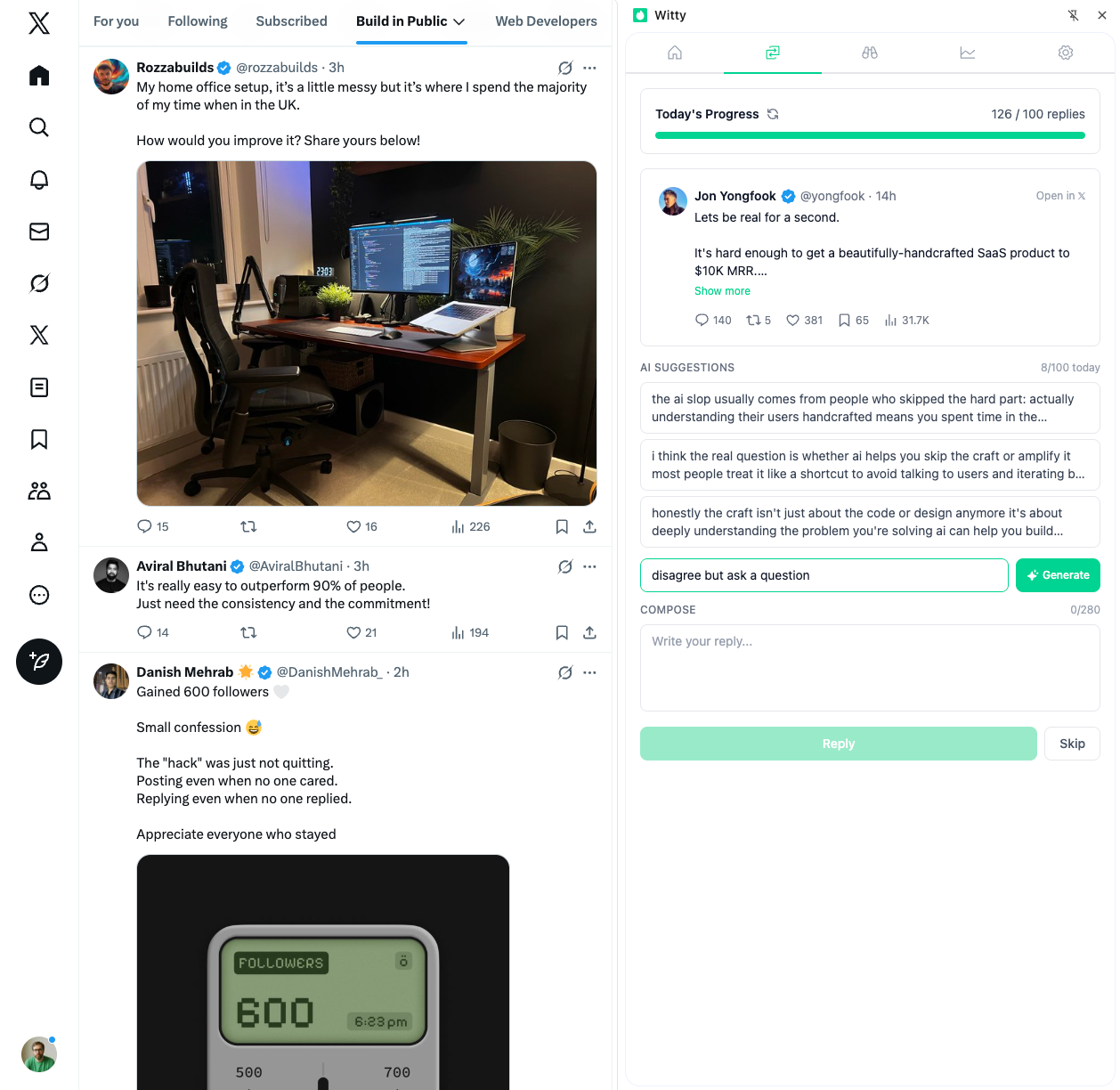
5 Reply Mistakes Every Beginner Makes
5 Reply Mistakes Every Beginner Makes
Replying seems straightforward. Read a post, write a comment, hit send. But most replies disappear without impact, and beginners often spend weeks making the same errors before realising why their engagement isn't translating to growth.
These five mistakes account for most wasted effort. Recognising them accelerates your learning curve.
Mistake 1: The Generic Validation
The reply: "Great post!" or "This is so true!" or "100% agree!"
Why it fails: Generic validation adds nothing. The original poster has seen thousands of these. They're noise, not signal. The algorithm doesn't reward them because they don't spark conversation. Other readers scroll past them because they contain no information worth stopping for.
The fix: Replace agreement with addition. Instead of "Great post!" try adding why it resonates: "This matches what I saw building our onboarding flow. We tried the opposite approach first and it failed for exactly the reason you describe." Specificity demonstrates genuine engagement. It gives the poster something to respond to and gives readers a reason to check your profile. Learn the anatomy of a high-value reply for more techniques.
Even a simple extension works better than validation alone. "Agree, and I'd add that this applies even more strongly for B2B" contains an actual idea, however small.
Mistake 2: Replying to Stale Posts
The timing: Commenting on posts that are 6, 12, or 24 hours old.
Why it fails: 𝕏 prioritises recency. Most of a post's engagement happens in the first hour. After that, distribution drops sharply. A reply to a post from yesterday lands in a thread that's already settled. The original poster has moved on. Their audience has moved on. Your reply reaches almost no one.
The fix: Focus on fresh posts. Turn on notifications for key accounts so you see their posts when they happen. Check your feed actively during your designated engagement time rather than catching up on what you missed. A good reply in the first 30 minutes outperforms a great reply three hours later. See early reply timing for more on why this works.
If you find a valuable older post, you can still engage for relationship-building purposes. Just don't expect visibility. The return on that reply is relationship equity with the poster, not reach.
Mistake 3: The Self-Promotional Pivot
The structure: Someone posts about productivity. You reply: "Interesting! Speaking of productivity, I wrote a thread about this last week: [link]"
Why it fails: This isn't a reply. It's an advertisement wearing a reply costume. The original poster didn't ask for recommendations. Other readers recognise the move instantly and discount your credibility. You've signalled that you view their post as a platform for your promotion rather than a conversation worth participating in.
The fix: Separate your engagement from your promotion. Replies should add value without expecting anything in return. Your profile link is in your bio. If your reply demonstrates expertise, curious readers will click through and discover your content naturally.
If you genuinely have relevant content to share, do it sparingly and contextually. "I explored this exact question in depth" works occasionally, when the relevance is undeniable and the poster might actually benefit. But the threshold should be high. Most attempts at "helpful" self-promotion read as spam.
Mistake 4: Targeting the Wrong Accounts
The approach: Replying exclusively to mega-accounts with millions of followers, or exclusively to accounts smaller than yours.
Why it fails both ways: Mega-accounts receive hundreds of replies per post. Your comment drowns in noise unless you're exceptionally early or exceptionally good. The competition for visibility is intense, and the poster rarely has time to respond, which limits relationship-building.
Accounts smaller than yours have limited reach. Your reply might get engagement, but it reaches fewer potential followers. You're not borrowing distribution; you're just participating.
The fix: Target the middle. Accounts with 5,000 to 50,000 followers often hit the sweet spot. See replying to big accounts and spotting tweets worth replying to. They're large enough to have real audiences but small enough to notice and respond to thoughtful engagement. Many are actively building their presence and appreciate genuine interaction.
Mix your targeting: some aspirational accounts for reach, some peer-level accounts for relationships, some smaller accounts where you can genuinely help. The portfolio approach compounds better than any single target type.
Mistake 5: Volume Without Quality
The behaviour: Posting 50 replies a day, each one quick and shallow.
Why it fails: The algorithm learns from engagement patterns. When your replies consistently get ignored, it signals low value. Your future replies may receive even less visibility as a result.
Beyond algorithmic effects, low-quality volume damages your reputation. Accounts that show up everywhere with nothing to say become recognisable in the worst way. People start associating your name with empty engagement rather than genuine contribution.
The fix: Invert the ratio. Quality multiplies; quantity alone doesn't. Ten thoughtful replies that spark conversation beat fifty generic ones. Each strong reply compounds through responses, profile visits, and relationship formation. This is why replies are the fastest path to growth.
Set a quality floor. Before posting any reply, ask: would I be proud to have this represent my thinking? If the answer is no, either improve it or skip it entirely.
The Pattern Beneath the Mistakes
All five mistakes share a common root: treating replies as a tactic rather than a conversation. When you view replies as a growth hack, you optimise for output rather than value. When you view replies as genuine participation, the strategic benefits follow naturally.
The accounts that grow through replies aren't gaming the system. They're contributing to conversations they actually care about, consistently, over time. The mechanics matter, but they work best when supported by genuine engagement.
Fix these five mistakes and your reply strategy improves immediately. The baseline quality lifts everything else. Continue learning with your first week of replies.
Related Articles

Reply-First vs Post-First: Which Strategy Wins on X?
Two competing philosophies for growth: focus on original content or focus on replies. Both have success stories, and both have traps. The right answer depends entirely on your current follower count and what you're optimizing for.
5 min read
How to Build a Reply Portfolio
Your posts reach your followers. Your replies reach everyone else. A reply portfolio is your collection of high-value replies that demonstrate expertise, attract profile visits, and build relationships. Every reply is an audition. People who see it are evaluating whether you're worth following.
7 min read
The Most Common X Growth Mistakes (and Fixes)
Everyone makes mistakes when growing on X. The difference between accounts that grow and accounts that stagnate often comes down to identifying and fixing these mistakes faster. Here are the most common pitfalls and how to address them.
7 min readYou've done the learning. Now put it into action.
Witty finds tweets worth replying to and helps you craft responses in seconds. Grow your audience without the grind.
No credit card required.