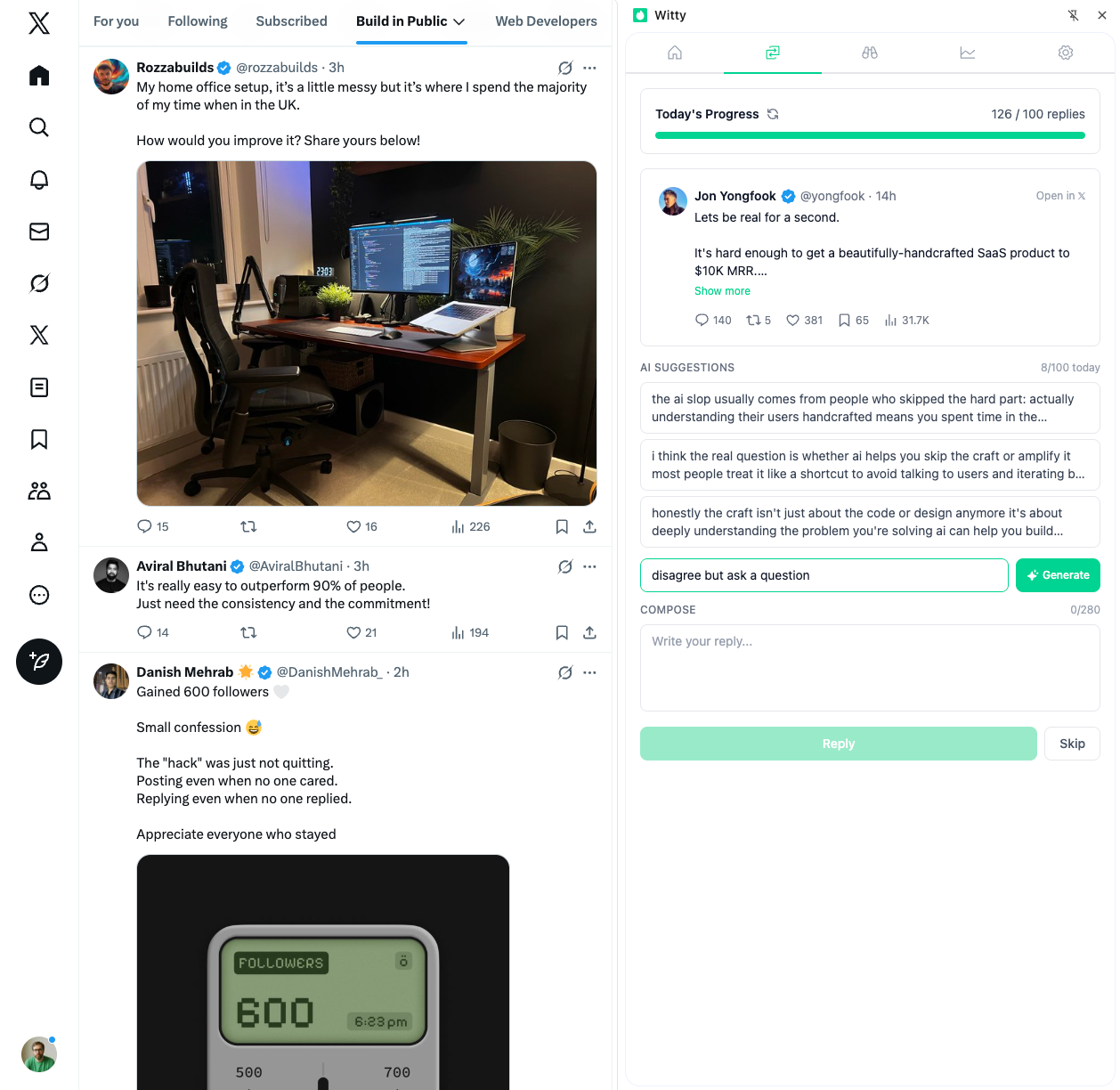
Reply Templates That Don't Feel Like Templates
Reply Templates That Don't Feel Like Templates
Templates have a bad reputation. And honestly, they've earned it.
"Great post!" Copy. Paste. Repeat. "I hope this message finds you well." Delete.
The problem isn't templates themselves,it's lazy ones. Generic replies get filtered, ignored, or worse, flagged as spam. Research shows personalized messages get 2x better response rates than templated blasts. People can smell copy-paste from a mile away.
But here's what most people miss: behind every effective reply is a structure. A framework. The best repliers aren't writing from scratch each time,they're adapting proven patterns to each situation.
The difference between a template and a framework is flexibility. Templates are rigid. Frameworks bend.
Why Rigid Templates Fail
Gmail and Microsoft now use machine learning to identify templated content. Yahoo's AI detects repetitive phrasing and reduces inbox placement. The same filtering happens in social feeds,pattern recognition flags robotic behavior.
Beyond algorithms, humans detect templates instantly. When a reply feels generic, it signals that the author:
- Didn't read carefully
- Doesn't value the interaction
- Is mass-producing engagement
That's the opposite of what builds relationships. A reply that adds nothing ends the conversation. A templated "Great thread!" is invisible.
The solution isn't to abandon structure,it's to use frameworks instead of scripts.
Frameworks vs. Templates
Templates are copy-paste scripts: "Hi [Name], loved your post about [Topic]. Here's what I think: [Generic statement]."
Frameworks are adaptable structures that guide your thinking while leaving room for genuine response.
Think of it like LEGO bricks. Templates give you a pre-built house,unchangeable. Frameworks give you building blocks you can assemble differently each time.
A framework for replying might be: Acknowledge + Add + Invite. That structure works for a thousand different tweets. But each reply using it will be unique because you're filling in the pieces based on what you actually want to say.
The Classic Reply Frameworks
These structures have worked for decades across mediums. Adapt them for X.
AIDA: Attention, Interest, Desire, Action
Grab attention with your opening line. Build interest with a relevant insight. Create desire by showing the value of your perspective. End with a clear action (often a question to continue the conversation).
Example: "The timing insight here is underrated. (Attention) I tested this exact approach last quarter,posting at 9 AM vs. 2 PM made a 40% difference in early engagement. (Interest/Desire) Have you noticed any time-zone effects with a global audience? (Action)"
Best for: Replies to educational or how-to content where you can add data or experience.
PAS: Problem, Agitate, Solution
Identify a problem the original post touches on. Agitate by expanding on the implications. Offer a solution or insight.
Example: "The consistency challenge is real. (Problem) I burned out twice trying to post daily,second time nearly quit entirely. (Agitate) What saved me was batching: one hour on Sunday creates the whole week. (Solution)"
Best for: Replies to posts about challenges or struggles.
BAB: Before, After, Bridge
Describe the situation before. Paint the picture after. Position the insight as the bridge between them.
Example: "Before implementing reply-first, I was getting maybe 50 impressions per post. After three weeks of strategic replies, that jumped to 800+. The bridge? Showing up in the right conversations instead of shouting into the void."
Best for: Replies where you can share a transformation story.
Reply Structures That Feel Natural
Beyond classic frameworks, here are structures specifically designed for X replies:
The Experience Drop
Acknowledge the point, share a specific experience with numbers or timeframe, extract the lesson.
"Completely agree. Spent 6 months posting without engaging,gained 200 followers. Switched to reply-first for 3 months,gained 2,000. The math isn't even close."
The Framework Add
Reference the insight, add your own framework or mental model, show how it applies.
"Love this. I use a simple filter: Does my reply add (A) experience, (B) data, (C) a different perspective, or (D) a useful question? If none of those, I don't post it."
The Curious Counter
Acknowledge validity, offer a nuanced disagreement, support with reasoning.
"Mostly agree, but there's a nuance: this works for established accounts. For new accounts under 500 followers, I'd actually recommend more posting to give the algorithm data about you."
The Specific Example
Connect to the point, share a concrete example with details, draw the implication.
"Perfect illustration yesterday: my reply to a thread about growth got 50 likes and drove 15 profile visits. Took 2 minutes. No post I wrote this week did better per minute invested."
The Synthesis
Acknowledge the conversation, synthesize multiple viewpoints, add expert perspective.
"Reading through this thread, I see two camps. Here's the synthesis: Both are right depending on account stage. Under 1K: focus on replies. 1K-10K: balance. 10K+: leverage for scale."
Adding Your Voice to Any Structure
A framework only works if you sound like you. Here's how to personalize:
Use contractions. "I'm reaching out" not "I am reaching out." "Don't" not "do not." Unless formality is your brand, contractions sound human.
Write like you talk. Read your reply out loud before posting. If it sounds stilted or unnatural, rewrite it. Your reply should sound like something you'd actually say.
Cut the generic openers. "I hope this finds you well" is a red flag. Start with something specific to the post you're replying to.
Add digital body language. Punctuation and occasional emojis show personality. One well-placed dash,like this,or a single emoji can add warmth. Overdo it and you sound manic.
Include something only you could say. Your specific experience. Your particular take. The detail that comes from your unique vantage point. That's what separates framework-assisted from copy-paste.
When to Use Structure vs. Pure Improvisation
Frameworks shine for:
- Common topics you address repeatedly
- Quick engagement during busy periods
- Maintaining consistency across many replies
- Breaking through writer's block
- Routine conversations with familiar patterns
Go pure improvisation for:
- Complex discussions requiring nuance
- Sensitive or emotional topics
- High-stakes conversations with important accounts
- Unique situations with no clear pattern
- Deep relationship-building moments
The hybrid approach works best: use a framework as your starting point, then personalize heavily based on context.
Building Your Personal Reply Library
Over time, build a collection of your own frameworks:
Audit your successful replies. Which ones got engagement? What structure did they follow? What phrases felt natural?
Document your patterns. Create a simple list: "For questions about X, I usually [structure]." "When someone shares a struggle, I [approach]."
Note your signature phrases. We all have verbal tics and favorite constructions. Lean into the ones that work.
Categorize by situation:
- Agreeing and adding
- Respectfully disagreeing
- Answering a question
- Sharing experience
- Asking a follow-up
- Congratulating or supporting
Each category gets its own framework.
The Final Check
Before posting any reply, run this mental checklist:
- Does this sound like me?
- Did I add something only I could add?
- Would I be proud of this reply?
- Could this stand alone as a mini-post?
- Is it as short as possible while remaining complete?
If yes to all five, hit post. If you're just going through the motions, either personalize more or skip the reply entirely.
The Speed Without Sacrifice Promise
This system should make you faster, not more generic. When you have frameworks, you're not staring at a blank reply box wondering what to say. You have a starting structure. The creative work becomes filling it in with your specific experience and voice.
Research shows modular email design cuts creation time from 2.5 hours to 30 minutes while maintaining quality. The same principle applies to replies: structure reduces friction without reducing authenticity.
The goal is replies that feel spontaneous,even though they're built on proven patterns. That's the paradox of good frameworks: they make natural-sounding responses faster to produce.
Related Articles

The 80/20 of X Growth: What Actually Moves the Needle
Most people on X are busy doing things that don't matter: A/B testing bios, obsessing over hashtags, posting at optimal times. The Pareto principle applies brutally here. Roughly 20% of activities produce 80% of results, and this guide shows you which ones.
5 min read
How to Find Your 'People' on X Without Cold DMing
Cold DMs don't work. Response rates hover around 4-8%, and most of those are polite rejections. Building real relationships requires a different approach: visibility first, conversation second, DMs only when you've earned them.
7 min read
Building a Daily Reply Habit That Actually Sticks
The 21-day habit myth came from a plastic surgeon's observations about appearance adjustment, not habit research. Actual formation takes 59-66 days on average. Leaders who started with minimal viable habits were 2.7x more likely to maintain them long-term. Here's how to build a reply habit that survives contact with real life.
8 min readYou've done the learning. Now put it into action.
Witty finds tweets worth replying to and helps you craft responses in seconds. Grow your audience without the grind.
No credit card required.