How to Build an Audience on X While Building a Product
How to Build an Audience on X While Building a Product
You're building a product. Every hour matters. You can barely keep up with development, customers, and operations.
And someone's telling you to also build an X presence?
Here's the reality: building audience and product simultaneously isn't just possible,it's advantageous. The question isn't whether to do both, but how to do both efficiently.
The Founder's Dilemma
The Time Equation
A typical founder day breaks down to 40 to 50 percent on product development, 20 percent on customer conversations, 15 percent on operations and admin, and often 0 to 10 percent on marketing and content. Every hour on 𝕏 is an hour not on product. The tension is real.
The "Build Then Market" Trap
The common approach involves spending 6+ months building in silence, launching to crickets, then scrambling to build an audience while burning runway.
The "Build in Public" Advantage
The better approach allows your audience to grow while the product develops. You launch to an engaged, waiting audience, feedback informs product direction, and validation happens during building. Founders who build in public report 3 to 5x higher launch engagement. Pre-launch community reduces customer acquisition costs. The audience becomes an asset.
The Minimum Viable X Presence
The question isn't "How much time should I spend on X?"
It's "What's the minimum that compounds while building?"
The answer: 30-45 minutes daily.
The 15-Minute Version (Busy Days)
On busy days, spend 5 minutes posting one update about your work and 10 minutes replying to 3 to 5 relevant posts in your space. That's maintenance mode.
The 30-Minute Version (Normal Days)
On normal days, spend 10 minutes creating one valuable post, 15 minutes engaging strategically through replies, and 5 minutes responding to comments on your posts.
The 45-Minute Version (When Possible)
When possible, spend 15 minutes on quality content creation, 20 minutes on strategic engagement, and 10 minutes on community maintenance through DMs and conversations.
The Non-Negotiable Mindset
Treat 𝕏 like brushing your teeth (a daily habit that's non-negotiable), like exercise (consistent and scheduled), and like email (done at specific times, not all day).
Building in Public: The Framework
What It IS
Building in public means transparent journey sharing, learning out loud, presenting authentic struggles alongside wins, and inviting your community into the process.
What It's NOT
Building in public is not sharing every single detail, constant promotion, daily metrics updates, or bragging about progress.
The Content Mix
| Content Type | % of Posts | Purpose |
|---|---|---|
| Progress updates | 25% | Shows momentum, invites accountability |
| Lessons learned | 25% | Demonstrates expertise, provides value |
| Questions/requests | 15% | Invites engagement, gets feedback |
| Behind the scenes | 15% | Humanizes the journey |
| Wins/milestones | 10% | Celebrates, inspires |
| Personal/life | 10% | Builds connection |
What to Share (and What to Keep Private)
Share what you're building at a high level, the problems you're solving, decisions you're making, lessons you're learning, and struggles and challenges. Keep private your specific competitive advantages, customer confidential information, investor negotiations (usually), and details that could hurt the business.
Content That Compounds While Building
The "Two Birds" Strategy
Create content that both builds audience by providing value and helps the product by getting feedback and validation. For example, "I'm deciding between approach A and B. Here's my thinking..." generates audience engagement while helping you make decisions. "Here's what I learned talking to 10 potential customers" provides content value while showing progress. "Building [feature] this week. What would you want from this?" creates engagement while conducting product research.
Low-Effort, High-Compound Content Types
The "Work Log" Post: "Today I'm working on [X]. Here's why this matters for [audience]..."
- Time: 5 minutes
- Value: Keeps you accountable, shows consistency
The "Learning Share" Post: "TIL: [Something you discovered while building]"
- Time: 5 minutes
- Value: Positions as learner, provides insight
The "Decision Post: "Trying to decide [X]. Options: A or B. What am I missing?"
- Time: 3 minutes
- Value: Gets feedback, creates engagement
The "Milestone Post:" "Just hit [milestone]. Here's what it took..."
- Time: 10 minutes
- Value: Celebrates progress, shows growth
Weekly Content Batching
In a 60 to 90 minute session, list 5 to 7 things you learned or did that week, turn each into a post draft, and schedule them throughout the week. Then daily you only need to engage, not create.
Strategic Engagement for Founders
Highest ROI Engagement
The highest ROI engagement activities are replying to potential customers, engaging with investors and advisors, connecting with peer founders, and building relationships with amplifiers. Use X Lists to organize these accounts.
Lower ROI Engagement
Lower ROI activities include replying to random large accounts, leaving generic comments, and having off-topic conversations.
The "Target 50" Approach
Identify 50 accounts: 10 potential customers, 10 investors or advisors in your space, 10 peer founders, 10 industry influencers, and 10 complementary businesses. Engage consistently with these 50 and build genuine relationships.
The Reply Sprint
The reply sprint is simple: set a timer for 15 minutes, find 5 relevant posts, leave 5 thoughtful replies, and you're done.
Leveraging Product Building for Content
Your Product IS Your Content
| Building Activity | Content Opportunity |
|---|---|
| Customer interviews | "Just talked to 10 users, here's what I learned" |
| Feature decisions | "Here's how I'm thinking about X feature" |
| Technical challenges | "Solved a tricky problem today, here's how" |
| Competitor analysis | "What I noticed looking at the market" |
| User feedback | "User said X, it changed how I think about Y" |
The Documentation Mindset
As you build, ask yourself whether something would be interesting to share, whether you learned something others might benefit from, and whether this is a decision others face. Document as you go through quick notes in a doc, voice memos while thinking, and screenshots of progress. Later, turn that documentation into content.
When Product Must Come First
Recognizing Priority Periods
Product needs complete focus when a critical deadline is approaching, when there's a major customer commitment, during a technical crisis, when a funding round is closing, or when team issues require attention.
The Sustainable Baseline
Even in crunch periods, maintain 1 scheduled post per day, quick responses to DMs, and brief engagement of about 10 minutes. This maintains presence without distraction.
Communicating Absence
If going quiet, let your audience know with a message like "Heads down on [X] for the next few weeks," set expectations, and return with an update. Audience respects focused building.
Building Pre-Launch Audience
The Launch Advantage
Pre-launch audience provides day 1 customers ready to buy, product feedback during beta, word-of-mouth amplification, press and media attention, and investor credibility.
Pre-Launch Timeline
Six or more months before launch, build a general audience around the problem space, establish expertise, and create community. Three to six months before launch, start hinting at what you're building, share journey content, and build anticipation. One to three months before launch, show specific product previews, create early access and waitlist opportunities, and foster community engagement around the launch. At launch, activate your built community, leverage relationships, and amplify through your network.
The Waitlist Strategy
Start by sharing what you're building and the problem you're solving. Create a waitlist landing page and share the link in your bio. Provide regular updates to maintain interest and offer exclusive access to waitlist members.
Balancing Act Strategies
Time-Boxing Everything
Sample founder schedule:
| Time Block | Activity |
|---|---|
| 8:00-8:30 AM | X engagement (first check) |
| 8:30 AM-12 PM | Product work (no X) |
| 12:00-12:30 PM | X check, respond to comments |
| 12:30-5 PM | Product work (no X) |
| 5:00-5:30 PM | X engagement (final check) |
| Evening | Off X |
The "Product Week" Rhythm
Structure your week so that Monday through Thursday is product focus with minimal 𝕏, Friday is content creation and engagement focus, and the weekend is for scheduled posts with light engagement.
Tools for Efficiency
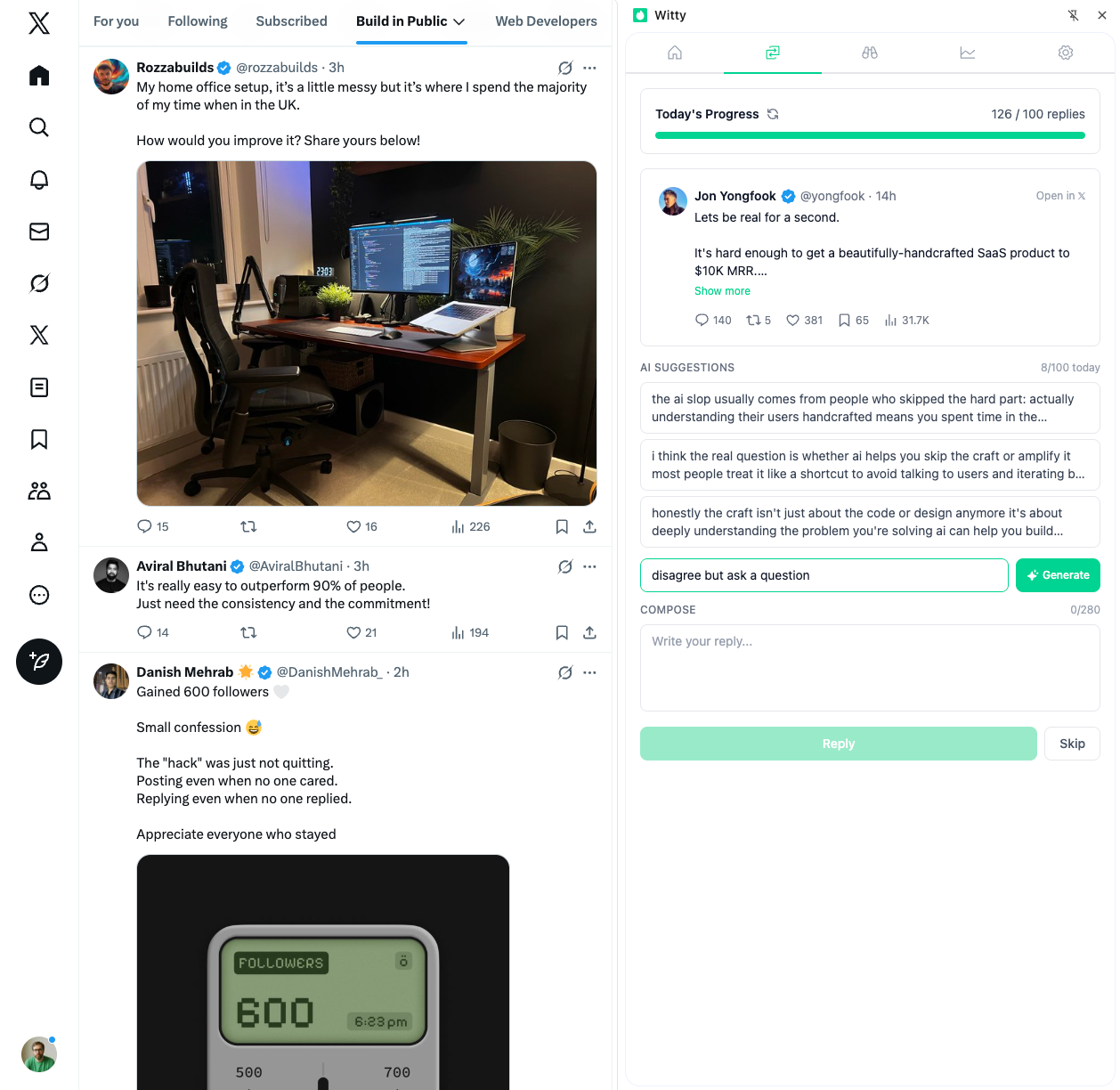
For engagement, a browser extension like Witty lets you queue replies and manage interactions efficiently without context-switching away from 𝕏. For notifications, turn off all except DMs and check at specific times only. For content banks, keep an ideas doc, save screenshots, and record voice notes.
The Long Game
The 18-Month Timeline
| Month | Product Focus | Audience Focus |
|---|---|---|
| 1-3 | Problem validation | Build initial presence |
| 4-6 | MVP development | Grow to 1-2K followers |
| 7-9 | Beta testing | Grow to 3-5K followers |
| 10-12 | Launch | Activate audience for launch |
| 13-18 | Growth | Leverage audience for growth |
Realistic Expectations
Expect 500 to 1,000 followers in months 1 through 3, 1,500 to 3,000 followers in months 4 through 6, and 3,000 to 7,000 followers in months 7 through 12. Aligned with product timeline, this is plenty for launch.
The Founder Advantage
You have what "content creators" don't: real stakes because you're building something, authentic stories that aren't manufactured, progress to share as natural content, and outcomes to demonstrate as social proof. Leverage this authenticity. It's your competitive advantage.
The Formula
Founder Audience Building = Consistency × Authenticity × Time-Efficiency
The Daily Minimum
Dedicate 15 to 30 minutes to 𝕏, create 1 post about your journey or learnings, write 5 to 10 replies to relevant accounts, and quickly respond to your own comments.
The Mindset
Product comes first, but audience compounds. Small consistent efforts beat sporadic big efforts. Your building journey is valuable content. Trust the process because launch day will thank you. For milestone-specific guidance, see the first 1,000 followers playbook.
You're not choosing between building a product and building an audience. You're building both,because they reinforce each other.
The audience makes the product launch work. The product gives the audience something to care about.
Build both. Win twice.
Related Articles

Building a Content Pillar on X: From Theme to Execution
Random content produces random results. A content pillar is a core theme you consistently create around. It transforms scattered posting into focused authority building. Without pillars, you're just another account posting about whatever comes to mind. With them, you become the go-to voice.
7 min read
Building in Public on X: What to Share (and What Not To)
Building in public has become one of the most effective growth strategies on X when done right. Share too little and you're just another account. Share too much and you'll overshare yourself into irrelevance or worse. The trick isn't radical transparency. It's strategic transparency.
7 min read
A Founder's Guide to Consistency on X
75.5% of content creators experience stress or anxiety from the pressure to post frequently. For founders juggling product development, fundraising, and hiring, that pressure compounds. Here's how to stay consistent without losing your mind or your startup.
7 min readYou've done the learning. Now put it into action.
Witty finds tweets worth replying to and helps you craft responses in seconds. Grow your audience without the grind.
No credit card required.